
Interested in joining York Rotary?
to submit an enquiry and obtain more information click here

PLANNED INTERNATIONAL
VISIT OF ERLANGEN TO YORK 2027
International Fellowship Visit to York May 2027
Internationaler Freundschaftsbesuch in York 2027
York Rotary look forward to hosting the next visit of Erlangen to York
York Rotary freut sich sehr auf den nächsten Besuch von Erlangen in York
May 6-9 2027/6-9 Mai 2027

.jpg)

PROGRAMME Programm
This is envisaged as being the final programme.
Dies ist als endgultiges Programme vorgesehen..
Thursday 6th May: Donnerstag, 6. Mai:
Arrival in York Ankunft in York
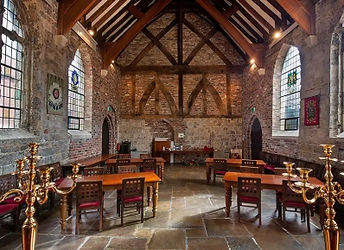
Evening - Welcome buffet at Bedern Hall York at 6.30 for 7.00pm, leaving Novotel at 6.00pm for the short walk to Bedern Hall. Wilkommensessen in .

Friday 7th May: Freitag, 7. Mai:
Morning - visit to the National Railway Museum for a special tour viewing historic engines, carriages and past royal trains.
Morgens - Besuch des


Lunch - York Rotary lunch meeting at the Novotel
Mittagessen -
Afternoon - Head to the Acomb area of York and visit the historic cold war bunker and Holgate windmill.
Nachmittag -


Evening - Head to the Bluebird cafe, Acomb for an evening of fun with music by Karl Mullen pianist and a fish and chips supper
Abend -


Saturday 8th May: Samstag, 8. Mai:
Morning - Leave York by minibuses at 9.15am and travel to visit Newby Hall. At Newby Hall we will have a guided tour of the house where we can see the lovely interior and the unique dolls house collection. After visiting the hall we can tour the gardens, view the special teddy bear collection and have options to ride on a miniature train and a short river trip on a narrow boat. We will enjoy lunch at Newby Hall before heading back to York.
Morgens - Sie verlassen York mit mit Kleinbussen um 9:15 und


Evening - Gala dinner revisiting the lovely Waterfront restaurant Naburn.
Abend - .


Sunday 9th May: Sonntag, 9. Mai
Following breakfast at the Novotel it will sadly be time to say goodby to York, but we are sure that members of York Rotary will breakfast at the Novotel before the farewells.
Nach dem Frühstück im Novotel wird es leider Zeit, sich von York zu verabschieden, aber wir sind sicher, dass die Mitglieder von York Rotary vor der Verabschiedung, im Novotel mitfrühstücken werden.
FURTHER DETAILS: WEITERE DETAILS:
The following are further details of some of the places that we plan to visit:
Im Folgenden finden Sie weitere Einzelheiten zu einigen der Orte, die wir besuchen wollen:
HOLGATE MILL: :
Holgate Windmill is Yorkshire’s only working windmill, standing proudly in Holgate, York. Built in the 18th century, the mill has survived changing ownership, new technology, and decades of quiet decline — and today it’s working once more thanks to dedicated volunteers.
Holgate Windmill has stood above York for more than 250 years. Today it is surrounded by houses and traffic, but when it was first built it looked out over open countryside, with clear views across the hamlet of Holgate and towards the city.
The mill was built by George Waud, who was born in Barlow near Selby in 1717. He bought the land on 27 December 1768 and, by October 1770, the mill was working. George lived nearby in the mill house with his family, and the new windmill soon became part of everyday life in the area.
At the time, Holgate was still a small settlement centred around the junction of Acomb Road and Poppleton Road, near The Fox Inn. These roads gave local farmers a direct route to the mill, bringing grain to be ground into flour. Much of the flour produced at Holgate would then have been taken into York.
Holgate Windmill continued grinding corn by wind power into the early 1930s. In January 1930, the sails were badly damaged in a storm. After this, the mill struggled on using electric motors, but production stopped entirely around 1933.
In 2001, the Holgate Windmill Preservation Society was formed. Thanks to the dedication of volunteers, the mill was eventually restored to working order.
Today, Holgate Windmill is once again a working windmill — not simply a monument to the past, but a living part of York’s heritage.
ACOMB COLD WAR BUNKER: :
The York Cold War Bunker was constructed in 1961 as part of Britain’s defence against the impact of a nuclear strike, should the Cold War escalate. The site operated within a national network of bunkers whose role was to observe and locate nuclear explosions, report on power and altitude, and track ensuing radiation.
This network came under the umbrella of the United Kingdom Warning and Monitoring Organisation (UKWMO), part of the Home Office, but it was operated by the Royal Observer Corps (ROC), a largely voluntary organisation which at the peak of its nuclear reporting role counted over 25,000 members nationally.
The York network was administered by one full-time and two part-time paid officers supporting several hundred volunteers across the group. Three evenings a week, ROC crews underwent training. Periodic exercises were conducted, the longest of which were staged over 24–36 hours. The bunker remained otherwise unoccupied, waiting for a change in the global political climate indicating a possible move toward conflict. Should tensions rise sufficiently, the ROC would be put on alert, with crews rotating round the clock at the Group Control. Had an imminent threat of attack been logged, the Control doorway would be closed, with the bunker containing those on duty committed to watching, waiting and responding.
Across the 30-year operational period, including during the Cuban Missile Crisis of 1962, the network was never put on full operational alert.
In 1989 a wave of popular uprisings brought an end to communist rule and Soviet dominance across Eastern Europe, symbolised by the fall of the Berlin Wall in November of that year. As the tensions and stand-off of the Cold War dissipated, the immediate threat of nuclear conflict lifted. The majority of the ROC was stood down on 30 September 1991, with the network of bunkers finally closing in March the following year. Aspects of the York Control were removed, notably communications kit, but otherwise its steel door was locked and the interiors remained untouched.
In 2000 English Heritage made the move to take what was, by then, a remarkably intact survival of Britain’s nuclear culture into its portfolio of properties. After a five-year programme of conservation and research, the site was opened as our most modern attraction.
NEWBY HALL: :
Newby Hall is considered yo be one of Britain's finest Adam Houses, home of Mr and Mrs Richard Crompton. The hall is an exceptional example of 18th century interior decoration built in the 1690s by Sir Christopher Wren, the house was later enlarged by John Carr and subsequently Robert Adam. Newby Hall's award winning gardens were mostly created in the 1920s and have evolved over the years.
70 intricate dolls houses displayed within the hall were bult up over 40 years and feature houses spanning all shapes, sizes and styles from various eras.
Gyles Brandreth's teddy bear collection is housed within a purpose built house within the gardens.